QR App

Memory Game

FIFA World Cup 2026

FIFA World Cup 2026

-  official site FIFA  -

FIFA World Cup 2026
June 11 – July 19, 2026

The 23rd FIFA World Cup was held across three countries: Canada, the United States, and Mexico. Forty-eight teams participated, divided into 12 groups. A total of 104 matches were played across 16 stadiums.

A World Cup-themed memory game offers a way to exercise your memory while also learning various facts about the tournament.

Discover the countries, flags, stadiums, teams, and matches that define this spectacular football celebration.

Players

Players    -  identical cards

Players (22 players)

Players (44 players)

Players (66 players)

Players (88 players)

Players     (Infocard)

Players   (Infocard)(22 players)

Players   (Infocard)(44 players)

Players   (Infocard)(66 players)

Players   (Infocard)(88 players)

Players    -  different cards

Players (22 players)

Players (44 players)

Players (66 players)

Players (88 players)

Countries

Countries    -  identical cards

Countries (48 countries)

Countries     (Info)

Countries   (Info) (48 countries)

Countries    -  different cards

Countries  +  Flags (48 countries)

Flags

Flags (48 countries)

Stadiums

Stadiums    -  identical cards

Stadiums (Exterior)

Stadiums (Interior)

Stadiums    -  different cards

Stadiums   (Info)

Stadiums (Exterior - Interior)

Groups

Groups (12 groups)

Other...

For the blind

Stadiums (keyboard)

Stadiums (mouse)

Extreme

Players (88 players)

Countries

Hidden back cards

Players

Flags

Matches

Matches     (Groups)

Group A

Group B

Group C

Group D

Group E

Group F

Group G

Group H

Group I

Group J

Group K

Group L

Matches played

Matches played

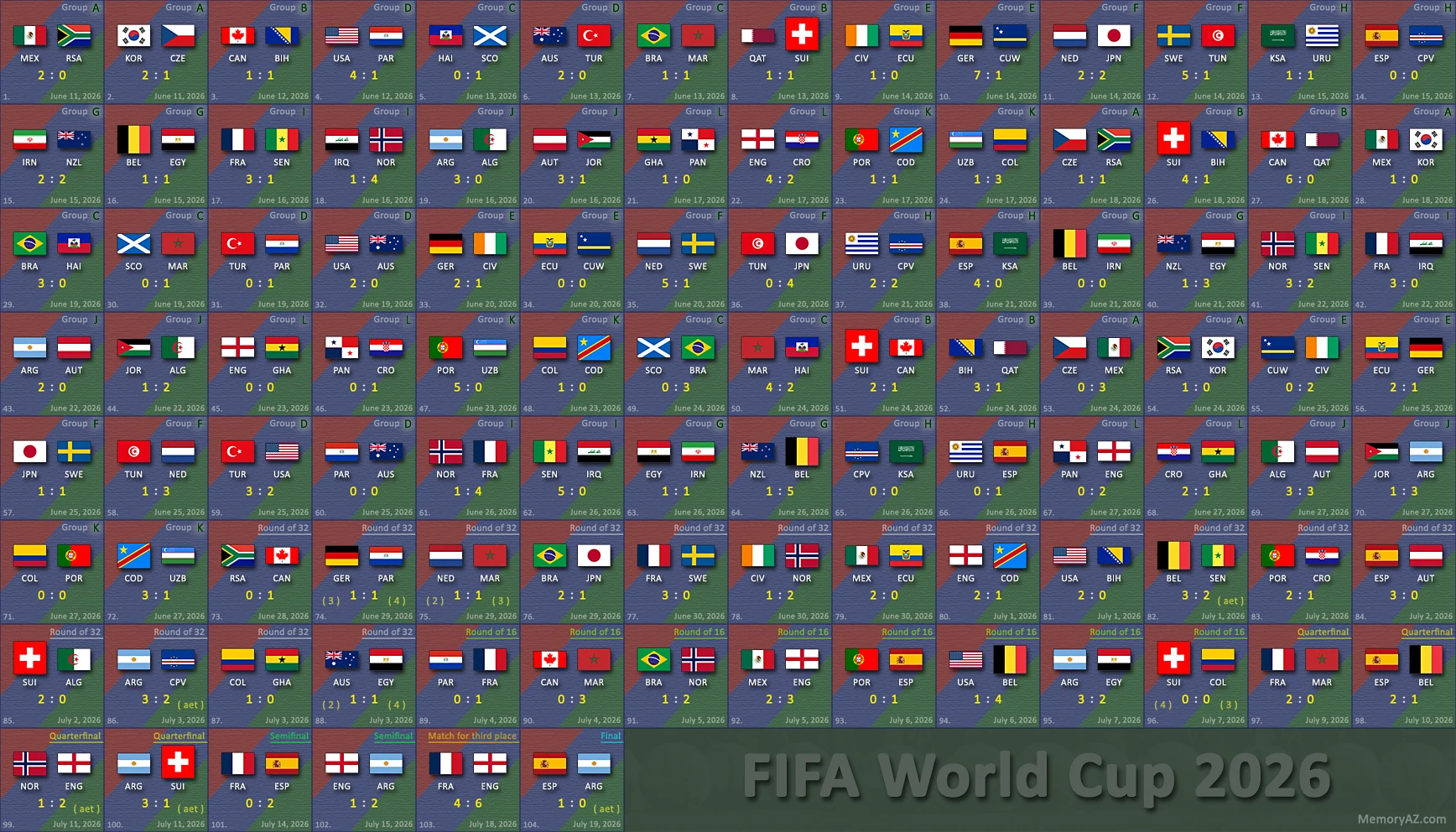
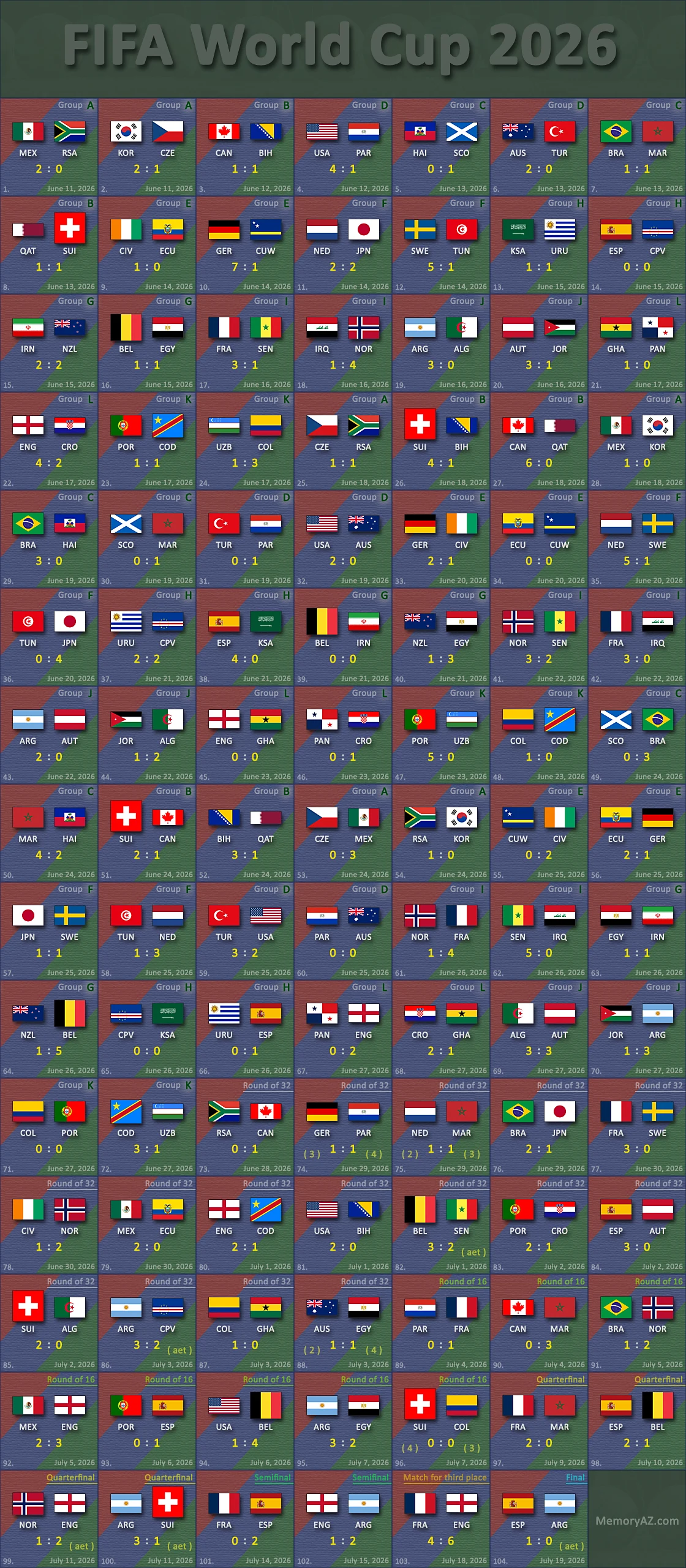
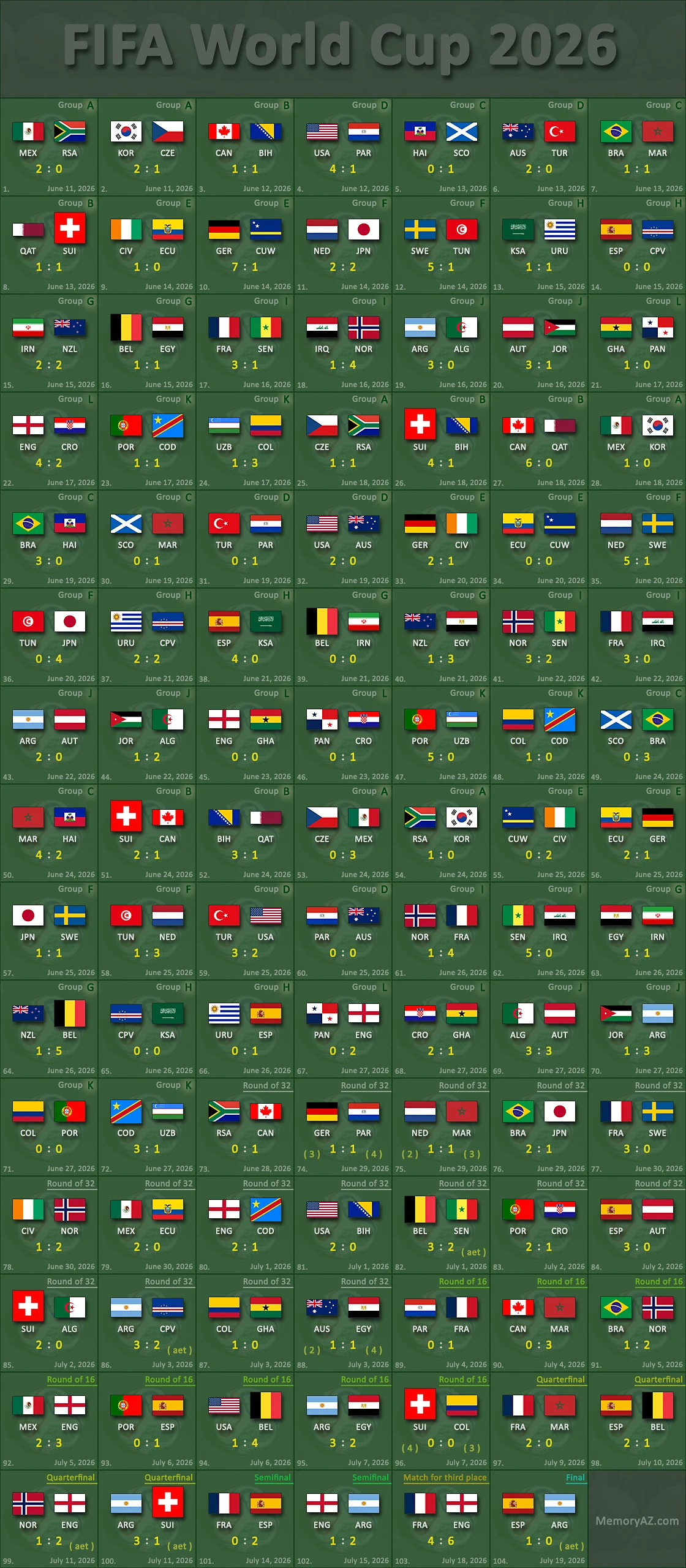
Match schedule + Results

Schedule + Results
(104 matches)
(Graphic version A - horizontal)

Schedule + Results
(104 matches)
(Graphic version B - horizontal)

Schedule + Results
(104 matches)
(Graphic version C - horizontal)

Schedule + Results
(104 matches)
(Graphic version A - vertical)

Schedule + Results
(104 matches)
(Graphic version B - vertical)

Schedule + Results
(104 matches)
(Graphic version C - vertical)

Matches     (Individual phases)

Group stage (72 matches)

Round of 32 (16 matches)

Round of 16 (8 matches)

Quarterfinals (4 matches)

Semifinals   +   For 3rd place   +   Final (4 matches)

Matches     (Stages overall)

Group stage (72 matches)

Group stage     -     Round of 32 (88 matches)

Group stage     -     Round of 16 (96 matches)

Group stage     -     Quarterfinals (100 matches)

Complete (104 matches)

QR codes

Players (22 players)
(picture - identical cards)

Countries + Flags (48 countries)
(picture - different cards)

Stadiums (Info)
(picture - different cards)

Random game
selection

Other NEW types of Memory Games

A
Face-Down Card Games
Card Matching
A1
Classic Memory
  • classic memory game
  • multiplayer game (classic mode or 1-turn mode)
  • play against the computer
  • supports pairs, triplets, quadruplets, ... up to octuplets
  • photo gallery mode

A classic memory game that can be enhanced with a chaotic card layout, gravity effects, or penalty STOP cards.

A2
Auto-Reveal Memory
  • game with automatic random reveal of the first matching card

The most difficult type of Memory Game in the world!
Every opening card is revealed by your opponent.
A simple classic memory game instantly becomes much more challenging and far more demanding on memory.
This is a real challenge!

A3
Auto-Play Memory
  • automatic gameplay by one or more computer players
  • up to 5 computer players competing against each other
  • adjustable intelligence level for each computer player (high, medium, and low level)
  • configure computer players (keyboard shortcut S)

Sit back, relax, and start the automatic game by pressing the PLAY button.
Watch the computer players carefully and try to remember the positions of individual cards.
The game can be paused and resumed at any time.

B
Face-Up Card Games
Card Selection
B1
Card Selection
  • select identical or different cards
  • game designed to improve concentration
  • game can be made more difficult or varied by laying out the cards chaotically (successive pressing of the keyboard shortcut Q)

The goal is to select all correct card pairs.

B2
Auto-Selection Mode
  • game with automatic random selection of the first matching card
  • select identical or different cards
  • game can be made more difficult or varied by laying out the cards chaotically (successive pressing of the keyboard shortcut Q)

Every opening card is selected by the opponent/computer.
The goal is to select all correct card pairs.

C
Learning Games
Card Guessing
C1
Learning Mode
  • guess matching cards
  • available only for different cards
  • cards can be presented in various learning modes (e.g. mixed mode Y)

Clicking a card reveals its matching counterpart.

C2
Auto-Learning Mode
  • guessing matching cards with automatic assistance
  • available only for different cards
  • cards can be presented in various learning modes (e.g. mixed mode Y)
  • configurable number of learning cycles

Sit back, relax, and start the learning session by pressing the START button.
Watch the card reveals carefully and try to absorb as much information as possible.
The game can be paused and resumed at any time.

Cards
« - »
QR info
× INFO

Title

Subtitle

Subtitle2

type: picture - text - sound

style: identical cards